Choosing a name for a child often inspires a deeper search into its meaning, origin, and spiritual significance. If you’re exploring the Roman name meaning in the Bible, you may wonder whether Roman is a biblical name and what it represents in Scripture.
The name Roman has Latin roots and is closely connected with the ancient Roman world. While Roman is not a personal name directly found in the Bible, the term “Roman” appears throughout the New Testament in references to Roman citizens, soldiers, and the Roman Empire.
In this guide, we’ll explore the Roman name’s meaning in the Bible, its Latin origin, historical background, biblical connections, and spiritual symbolism. You’ll discover how the name can be understood in relation to strength, purpose, faith, and history.
What Is the True Meaning of the Name Roman in the Bible?
The honest, direct answer is this: the name Roman does not appear as a proper name in the original Hebrew or Greek Scriptures. It is not a “biblical name” in the same sense as David, Peter, or Esther.
However, the concept behind Roman citizenship, Roman law, and the Roman Empire is woven throughout the New Testament, especially in the Book of Acts and the Epistle to the Romans.
So when people search for the Roman name meaning in the Bible, what they usually find is a blend of two things:
- The Latin meaning of Roman (“of Rome” or “citizen of Rome”)
- The spiritual symbolism tied to Rome’s role in the story of early Christianity
Understood this way, the Roman name meaning in the Bible becomes richer than a dictionary definition. It reflects themes of authority, transformation, and a person’s identity being reshaped by faith much like Paul, a Roman citizen, whose life was completely transformed after encountering Christ.
Origin and Historical Background of the Name Roman
The name Roman comes from the Latin word Romanus, meaning “a man of Rome” or “citizen of Rome.” In ancient times, being Romanus wasn’t just about geography it was a legal status. Roman citizens had protections under Roman law that non-citizens did not, including the right to a fair trial and exemption from certain punishments.
Over the centuries, the name spread far beyond Italy:
| Region | Name Form | General Meaning |
| Ancient Rome (Latin) | Romanus | Citizen of Rome |
| Slavic countries | Roman / Роман | Strong, of Rome |
| Spain & Latin America | Román | From Rome |
| France | Romain | Roman, strong |
| Greece (Byzantine) | Romanos | Roman, belonging to Rome |
This spread shows how the name carried the prestige and strength associated with the Roman Empire into dozens of cultures, eventually becoming a popular Christian name in Eastern Europe, where several saints and rulers bore it.
Is Roman a Biblical Name or Derived from the Roman Empire?
This is one of the most common points of confusion. Strictly speaking, Roman is a Latin-derived name tied to the Roman Empire, not a Hebrew name given by God to a biblical figure. You won’t find a person named “Roman” walking through the pages of Genesis or the Gospels.
That said, the word “Roman” (referring to Roman citizens, soldiers, and authorities) appears constantly in the New Testament.
The apostle Paul identified himself as a Roman citizen in the Book of Acts, and an entire epistle in the Book of Romans is addressed to the early Christian community living in Rome. So while Roman isn’t a biblical name in the traditional sense, its roots run directly through biblical history.
Roman Name Meaning in Hebrew, Greek, and Early Christian Context
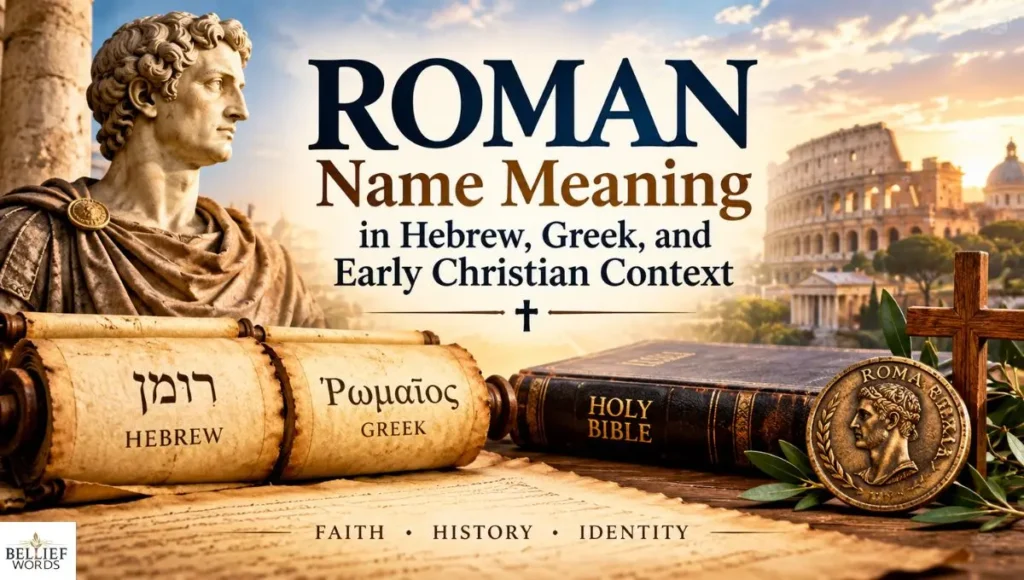
To fully answer the Roman name meaning in the Bible, it helps to look at how each biblical language relates to the word.
The Hebrew Perspective: Rom (רם)
Interestingly, there is a separate Hebrew root rom that sounds similar to “Roman” but has an entirely different origin.
This Hebrew word means “high,” “lifted up,” or “exalted.” It appears in various forms throughout the Old Testament, including in Habakkuk 3:10, where it describes something being raised on high.
While this is not the direct source of the name Roman, many people find spiritual meaning in the coincidence, associating the name with being “exalted” or “raised up” by God.
The Greek Context: Rōmaios (Ῥωμαῖος)
In the Greek New Testament, the word Rōmaios refers specifically to a Roman citizen. This term appears in key moments of the Book of Acts, particularly when Paul asserts his citizenship to avoid unlawful punishment.
The Greek usage of this word is tied entirely to legal status and political identity within the empire.
The Early Christian Transformation
As Christianity spread through the Roman Empire, the word “Roman” slowly shifted in meaning. It went from representing an empire that persecuted believers to describing a region and people central to the growth of the early church.
This transformation from opposition to belonging is part of why the Roman name meaning in the Bible carries such a strong redemptive undertone for modern believers.
Deep Spiritual Meaning Behind the Name Roman
Beyond etymology, many Christian parents and namesakes connect Roman to deeper spiritual themes drawn from its biblical associations.
1. Chosen for a Divine Purpose
Just as Paul’s Roman citizenship became a tool God used for the spread of the gospel, the name Roman is often associated with being positioned even unknowingly for a greater purpose.
2. Exalted and Lifted Up by Grace
Drawing from the Hebrew root rom, some believers interpret the name as a reminder of being lifted up, spiritually exalted, or raised above former circumstances through faith.
3. Unashamed Spiritual Boldness
Paul’s letter to the Romans opens with the declaration that he is “not ashamed of the gospel.” This boldness has become closely tied to how the name Roman is viewed in Christian circles as a name for someone unafraid to stand firm in belief.
Don’t Miss: Bible Verse Wallpaper Black
Roman Name in the Bible: Historical References and Interpretation
While “Roman” as a personal name isn’t recorded in Scripture, the word appears repeatedly as a description of people, soldiers, and legal status:
- Paul declares his Roman citizenship before being flogged (Acts 22:25–29)
- Roman soldiers guard Jesus’ tomb (Matthew 27:65–66)
- Pilate, a Roman governor, presides over Jesus’ trial (John 18–19)
- The Book of Romans is written to believers living in the city of Rome
Each of these references shapes how modern readers interpret the historical weight behind the name.
Role of Romans in the Bible and Early Christianity
Romans played a complicated but crucial role in the biblical narrative. On one hand, Roman authorities were responsible for the crucifixion of Jesus and later persecuted many early Christians.
On the other hand, Roman roads, trade routes, and relative political stability (the Pax Romana) allowed the gospel to spread rapidly across the known world.
This dual role persecutor and unintended enabler of Christianity’s growth is one of the most fascinating threads for anyone studying the Roman name’s meaning in the Bible from a historical lens.
Roman Soldiers, Empire, and Their Biblical Significance
Roman soldiers appear throughout the Gospels and Acts. A Roman centurion is praised by Jesus for his faith (Matthew 8:5–13). Roman soldiers crucify Jesus, yet a centurion at the cross proclaims, “Surely this man was the Son of God” (Mark 15:39).
These moments show that even within the machinery of the empire, individuals encountered genuine faith, a theme that continues to shape how people view Roman symbolism in Christianity today.
What the Bible Says About Rome and Its Symbolism
The city of Rome itself is directly named in several New Testament passages, most notably in the Book of Romans and the Book of Acts, where Paul eventually travels to Rome as a prisoner.
In prophetic literature, Rome is often connected (by many scholars) to imagery of powerful, oppressive empires, a symbol of worldly power set against God’s eternal kingdom.
Symbolism of Roman Name in Christianity and Faith
In modern Christian naming culture, Roman symbolizes:
- Strength under authority
- A steady, unshakable identity
- Transformation from worldly power to spiritual purpose
- Boldness in proclaiming one’s beliefs
Parents who choose the name Roman for their children often cite these themes, alongside its connection to the Book of Romans, one of the most theologically rich books in the New Testament.
Roman Empire Symbolism in Biblical Prophecy
Many theologians associate the Roman Empire with the “fourth kingdom” described in the Book of Daniel a powerful, iron-like empire that eventually gives way to God’s everlasting kingdom.
Regardless of interpretation, this prophetic thread reinforces Rome’s reputation in Scripture as a symbol of immense but ultimately temporary earthly power.
Is the Name Roman Associated with Strength and Leadership?
Yes. Historically, Roman citizens held legal privileges that reflected power and protection. Roman law, government structure, and military discipline became models of order and leadership for centuries afterward.
This is a major reason the name Roman is still associated with strength, discipline, and leadership qualities today, both in secular and Christian naming traditions.
Biblical Verses That Connect with the Meaning of Roman
A few passages often quoted alongside the name’s meaning:
- Habakkuk 3:10 — connects to the Hebrew root rom, describing something “lifted up.”
- Romans 1:16 — “I am not ashamed of the gospel,” reflecting spiritual boldness.
- Acts 22:28 — Paul’s declaration of Roman citizenship “I was born a citizen.”
- Romans 8:37 — “In all these things we are more than conquerors,” a verse often linked to the strength theme of the name.
How the Name Roman Can Inspire a Christian Life
For believers who carry or choose this name, the inspiration often comes from combining its historical strength with its spiritual undertones living boldly, standing firm in faith, and allowing one’s identity to be transformed the way Rome itself was transformed from a center of persecution into a center of the Christian faith.
Strength, Authority, and Leadership Meaning of Roman Name

The Power of Boundaries and Execution
Roman law was known for order and structure. Symbolically, this translates into a personality trait often associated with the name: someone who values discipline, follows through on commitments, and respects order.
Spiritual Pillars of Strength
Just as Roman architecture used strong pillars to support massive structures, the name is often linked metaphorically to being a “pillar” of strength within a family, community, or faith group.
Psychological Meaning of the Name Roman (Power & Identity)
From a psychological standpoint, names shape identity and self-perception. Roman, with its historical ties to power, order, and empire, is often perceived (by naming psychologists and parents alike) as conveying confidence, leadership, and resilience.
Children named Roman are frequently described by parents as strong-willed, grounded, and steady.
Roman Name Meaning in Different Cultures and Languages
The Slavic Regions: Roman
In Russia, Ukraine, and other Slavic countries, Roman (Роман) is an extremely popular given name, historically borne by princes, saints, and rulers, including Roman the Great of Kiev.
The Spanish-Speaking World: Román
In Spanish, Román carries the same “from Rome” meaning and is a well-used name across Spain and Latin America, often chosen for its strong, classic sound.
The French Landscape: Romain
The French form, Romain, keeps the same root meaning while adding a softer phonetic style, popular throughout France and French-speaking regions.
Popularity of the Name Roman in Modern Times
Roman has seen a steady rise in popularity in the United States and Europe over the past two decades.
Parents are drawn to its short, strong sound, its historical depth, and for many Christian families its connection to the Book of Romans. It pairs well with classic biblical middle names like Ezra, Micah, or James.
Roman Name in Today’s Christian Identity and Faith Perspective
Today, many Christian parents choose the name Roman not because it’s a name from Scripture, but because of what it represents: strength refined by faith, and an identity that like the early Roman believers can be transformed by the gospel regardless of its worldly origin.
Key Lessons Believers Can Learn from Roman History in the Bible
1. God is the Ultimate Director of History
Empires rise and fall, but Scripture consistently shows that even powerful nations like Rome operate within God’s sovereign plan.
2. True Citizenship is a Matter of the Heart
Paul often contrasted his earthly Roman citizenship with a greater, heavenly citizenship (Philippians 3:20), reminding believers that identity in Christ outweighs any earthly status.
3. Redemptive Transformation is Available to All
Rome shifted from persecuting Christians to becoming a center of the Christian faith proof that no person, city, or empire is beyond the reach of transformation.
Conclusion
The Roman name’s meaning in the Bible isn’t found in a single verse or a direct biblical character, but in the rich tapestry of history, law, and faith that surrounds the word “Roman” throughout Scripture.
From Paul’s citizenship to the Book of Romans, the name carries themes of strength, boldness, and transformation that continue to resonate with believers today.
Whether you’re considering the name for a child or simply exploring its roots, Roman stands as a reminder that identity whether tied to an empire or a name can always be reshaped by faith, purpose, and grace.
Frequently Asked Questions
Is Roman a name found directly in the Bible?
No, Roman is not used as a personal name in Scripture, but the word “Roman” appears often, referring to citizens, soldiers, and the empire itself.
What does the name Roman mean in Latin?
In Latin, Roman comes from Romanus, meaning “citizen of Rome” or “man of Rome.”
Is there a Hebrew word similar to Roman?
Yes, the Hebrew word rom means “lifted up” or “exalted,” though it isn’t the direct origin of the name Roman.
Was Paul in the Bible a Roman citizen?
Yes, Paul declared his Roman citizenship in Acts 22, which protected him from unlawful punishment.
Why is a book of the Bible called Romans?
The Book of Romans was written by Paul to Christian believers living in the city of Rome.
Is Roman a good name for a Christian baby?
Many Christian parents choose Roman for its strength, biblical connections through the Book of Romans, and its themes of faith and transformation.

Welcome to beliefwords! I’m Danish Ali. Christian Faith Writer | 4+ Years Bible Study Experience | Founder of (beliefwords.com)
Sharing prayers, Daliy Bible Verses, Blessings, Name Meanings and biblical wisdom to strengthen your faith.