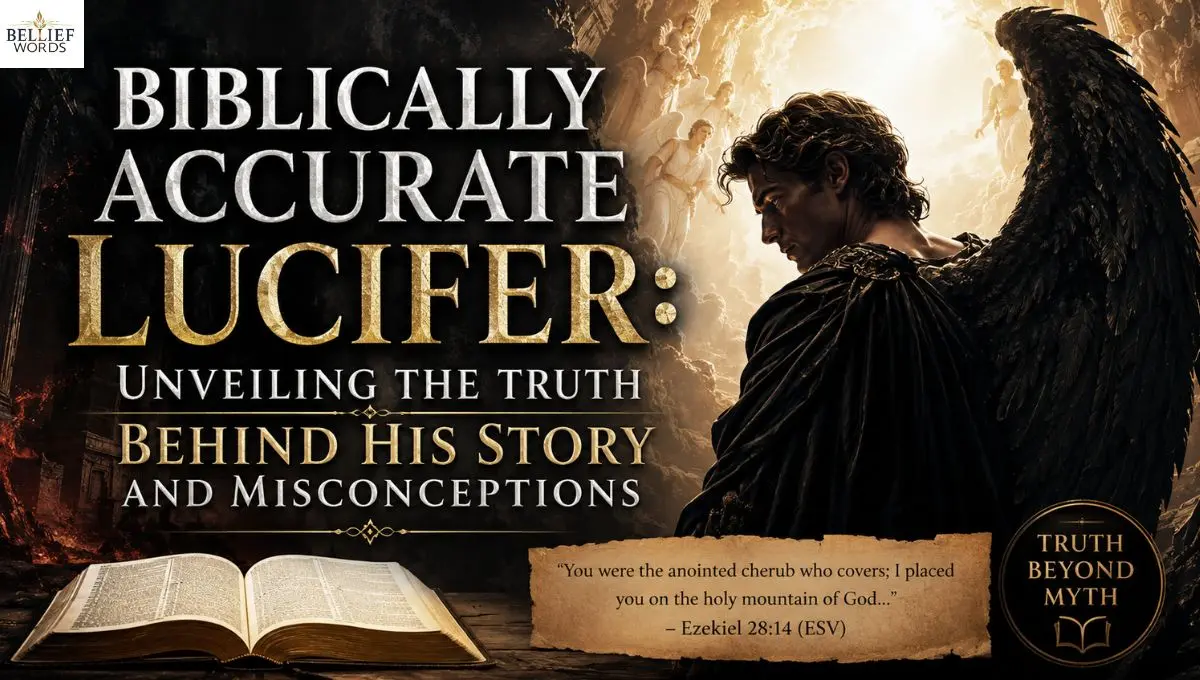
The biblically accurate Lucifer is very different from the horned, red-skinned figure often shown in movies and popular culture. The Bible describes a created being of remarkable beauty and wisdom whose pride led to his downfall, but many common beliefs come from later traditions rather than Scripture.
This guide explores the Hebrew meaning of Helel, key passages in Isaiah 14 and Ezekiel 28, the origin of the name “Lucifer,” and the relationship between Lucifer and Satan. Discover what the Bible actually says and separate biblical truth from centuries of myths and misconceptions.
Biblically Accurate Understanding of Lucifer’s Identity
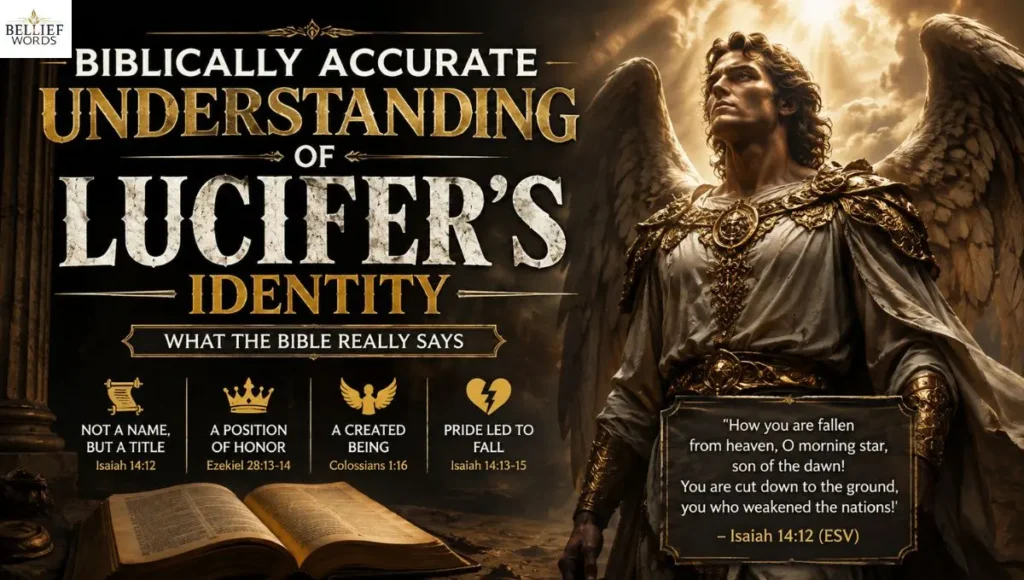
Getting the biblically accurate Lucifer right starts with admitting how little the Bible actually says about him directly. A biblically accurate Lucifer is defined by two short prophetic passages, not by tradition.
The name appears once in the King James Version, in a single verse of Isaiah, and the passages theologians connect to his fall are brief, poetic, and layered with symbolism. Everything else, the horns, the red skin, the pitchfork was added later by artists, playwrights, and storytellers.
Common Misconceptions About Lucifer in Modern Culture
Ask most people to describe Lucifer, and they’ll describe a devil costume.That image has almost nothing to do with the biblical text. Scripture never links this figure to fire-colored skin or physical deformity; those traits developed centuries after the Bible was written.
Popular Misunderstandings:
- Lucifer is portrayed with red skin, horns, and a tail none of which appear in Hebrew Scripture.
- “Lucifer” is treated as a proper name, when it originally functioned as a descriptive title.
- Lucifer and Satan are automatically assumed to be the same figure throughout the entire Bible.
- His fall is imagined as a dramatic battle scene, though Scripture describes it in only a few verses.
- He’s pictured ruling hell with a pitchfork, an image borrowed from medieval theater, not the Bible.
What Scripture Actually Reveals About Lucifer
The biblical material connected to this figure is limited to two Old Testament passages: Isaiah 14:12–15 and Ezekiel 28:11–19. Both are addressed, on the surface, to human kings the King of Babylon in Isaiah and the King of Tyre in Ezekiel.
Many interpreters believe the language rises beyond what any human ruler could embody, pointing to a heavenly being whose pride led to a catastrophic fall. Scripture describes this being’s original glory, his pride, and his judgment but it gives almost nothing about his appearance after the fall.
The Hebrew Original: Helel and Its True Meaning
The Hebrew word behind Isaiah 14:12 is helel (הֵילֵל), not “Lucifer.” Helel is built from a root meaning “to shine” and is commonly translated “shining one” or “day star.” The verse addresses this figure with the phrase helel ben-shachar “shining one, son of the dawn.”
Helel: Linguistic Analysis
| Hebrew Term | Transliteration | Literal Meaning | English Rendering |
| הֵילֵל | Helel | Shining one | Morning star / day star |
| בֶּן־שָׁחַר | Ben-Shachar | Son of the dawn | Son of the morning |
| הֵילֵל בֶּן־שָׁחַר | Helel ben-Shachar | Shining one, son of the dawn | “O Lucifer, son of the morning” (KJV) |
This phrase is poetic imagery describing brilliant light fading at sunrise, a fitting picture for a proud king (or angelic being) brought low. Understanding Helel is the starting point for any biblically accurate Lucifer discussion.
Jerome’s Latin Vulgate and the Birth of ‘Lucifer’
The name “Lucifer” entered Christian tradition through Jerome’s Latin Vulgate, completed around A.D. 405. Jerome translated helel as lucifer, a Latin word meaning “light-bringer” or “morning star” itself a name Romans used for the planet Venus at dawn.
Jerome wasn’t inventing a proper name for a fallen angel; he was translating a Hebrew description into its closest Latin equivalent.
King James Translation and English Christian Tradition
When the King James translators worked thirteen centuries later, they carried Jerome’s Latin word straight into English rather than translating it as “morning star.” That decision in Isaiah 14:12 is the only reason English readers associate the name “Lucifer” with the devil at all. Once printed in the KJV, the word took on a life of its own in English preaching, art, and literature.
Translation Comparison Across Versions
| Bible Version | Isaiah 14:12 Rendering |
| King James Version (KJV) | “How art thou fallen from heaven, O Lucifer, son of the morning!” |
| New International Version (NIV) | “How you have fallen from heaven, morning star, son of the dawn!” |
| English Standard Version (ESV) | “How you have fallen from heaven, O Day Star, Son of Dawn!” |
| New American Standard Bible (NASB) | “How you have fallen from heaven, O star of the morning!” |
Notice that only the KJV uses “Lucifer” as though it were a personal name. Every modern translation returns to the original meaning: morning star, or shining one, a key reason serious study of the biblically accurate Lucifer always starts with the Hebrew text rather than the English name.
Biblically Accurate Description of Lucifer’s Appearance
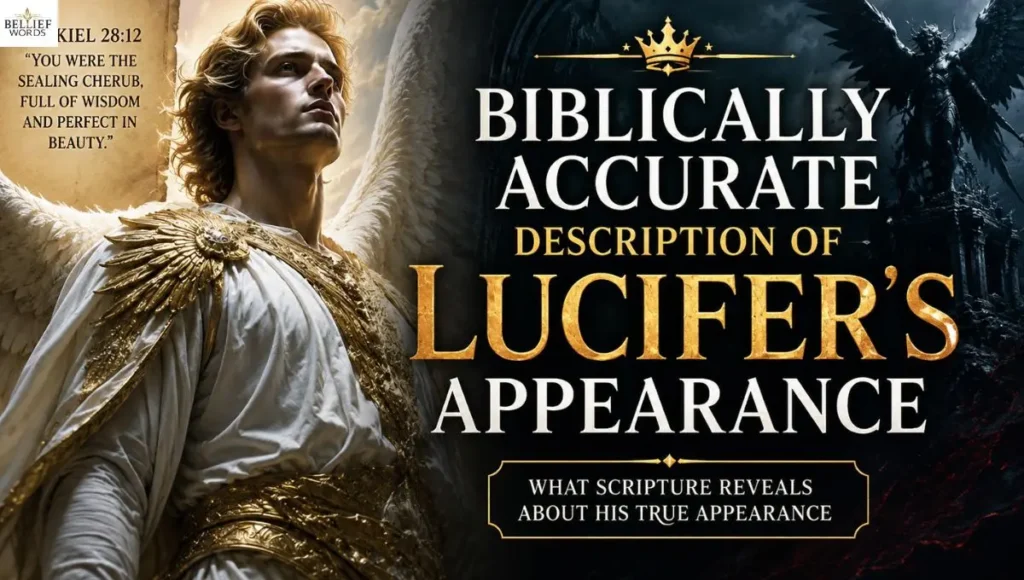
If popular culture is wrong about anything, it’s appearance.The Bible never gives Lucifer horns, a tail, red skin, or a pitchfork.
What it does give is a description of overwhelming pre-fall beauty, followed by near silence about what he looks like now. This is where a biblically accurate Lucifer diverges most sharply from popular imagination.
Don’t Miss: Warfare Prayer Points: 5 Scripture-Based Declarations
Lucifer’s Pre-Fall Glory According to Ezekiel
Ezekiel 28:12–15 offers the most detailed description connected to this figure, calling him “the seal of perfection, full of wisdom, and perfect in beauty.” He is placed in “Eden the garden of God,” covered with precious stones, and identified as “the anointed cherub that covereth.” Verse 15 states plainly: “Thou wast perfect in thy ways from the day that thou wast created, till iniquity was found in thee.”
Ezekiel’s Description of Original Splendor
- Adorned with nine precious stones, including sardius, topaz, and diamond (Ezekiel 28:13).
- Positioned as “the anointed cherub that covereth,” a guardian role of high honor.
- Walking “up and down in the midst of the stones of fire,” language associated with God’s holy presence.
- Described as flawless “from the day that thou wast created” until sin was found in him.
The Morning Star Imagery in Isaiah’s Prophecy
Isaiah’s passage doesn’t describe physical features at all; it describes a fall from brilliance, another detail that keeps the biblically accurate Lucifer distinct from horror-movie depictions. The “morning star” title itself communicates radiant, dawn-breaking light, the kind of beauty associated with the brightest object in the pre-sunrise sky.
Morning Star Symbolism:
- Represents the brightest, most prominent light visible just before sunrise.
- Signals dramatic reversal: light-bringer overthrown into darkness.
- Echoes ancient Near Eastern myths of a rebellious lesser god cast from the heavens.
- Used elsewhere in Scripture (Revelation 22:16) as a title for Christ, which is why interpreters urge caution in reading Isaiah 14 as a literal name for Satan.
Does Lucifer Possess Physical Form After His Fall
Scripture is remarkably quiet here. The Bible describes Satan’s activity accusing, deceiving, tempting far more than his form. When he does appear symbolically, it’s through imagery like a serpent (Genesis 3) or a “great red dragon” in apocalyptic vision (Revelation 12:3), not a literal physical description.
Post-Fall Manifestation Possibilities
- Serpent imagery in Genesis 3, understood by most scholars as symbolic rather than literal.
- The “great red dragon” of Revelation 12, appearing in apocalyptic, symbol-heavy literature.
- References to Satan disguising himself “as an angel of light” (2 Corinthians 11:14), suggesting no fixed monstrous form.
- No verse anywhere describes a current, literal physical body for this being.
What Biblical Silence Tells Us Lucifer Is Not
Because Scripture stays silent on so many details, it’s worth naming what simply isn’t there. This silence is itself informative.
Unbiblical Attributes:
- Red skin is never mentioned in any biblical text.
- Horns and a tail borrowed from pagan nature deities absorbed into medieval Christian art.
- A pitchfork a theatrical prop with no scriptural basis whatsoever.
- Permanent residence “ruling” hell Scripture actually describes hell as his future judgment, not his throne room.
Bible Verses About Lucifer Explained in Context
Context changes everything. Reading these passages as they were originally addressed reveals a far more layered picture than a simple angel-turned-devil story, and it’s essential reading for anyone researching the biblically accurate Lucifer in depth.
Isaiah 14:12–15: The King of Babylon or Satan?
Isaiah 14:4 explicitly frames the entire chapter as “a proverb against the king of Babylon.” The taunt describes a proud ruler struck down, boasting “I will ascend into heaven… I will be like the most High” (Isaiah 14:13–14), then cast down to Sheol.
Many scholars read this as pointed political poetry mocking a tyrant’s arrogance. Others believe the language is too cosmic for any human king and see a dual reference to a human ruler on the surface, with a heavenly rebellion echoing underneath.
Ezekiel 28:11–19: The King of Tyre and Symbolic Language
Ezekiel 28 opens the same way, addressed to “the prince of Tyre” (verse 2), then shifts in verse 12 to “the king of Tyre,” described in terms that go beyond any earthly ruler placed in Eden, covered in jewels, called a guardian cherub.
That shift has led many interpreters, from the early church onward, to see this section describing a heavenly being whose pride corrupted his perfection, using the king of Tyre as a mirror for a much older rebellion.
Luke 10:18 and Revelation 12: Understanding Satan’s Fall
Jesus himself references a fall in Luke 10:18: “I beheld Satan as lightning fell from heaven.” Revelation 12:7–9 describes a war in heaven where the dragon “that old serpent, called the Devil, and Satan”is cast down along with a third of the stars.
These New Testament passages don’t use the name “Lucifer” at all, but they’re the texts most directly connecting Satan’s identity with a heavenly rebellion and fall.
Critical Distinction Between Lucifer and Satan in Scripture
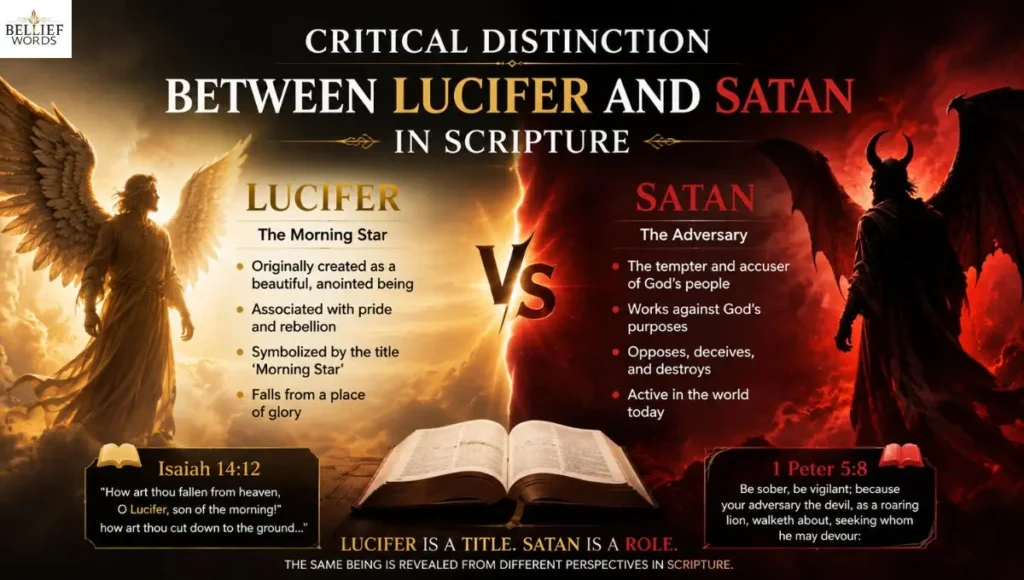
Christian tradition treats “Lucifer” and “Satan” as interchangeable names for the same figure. A closer look at the biblical text shows this equation developed over time rather than being explicitly stated in Scripture itself, a distinction central to any biblically accurate Lucifer study.
Biblical Evidence Supporting Their Distinction
“Lucifer” appears exactly once in the King James Bible, translating the Hebrew helel in Isaiah 14:12. “Satan” (שָׂטָן), by contrast, appears dozens of times throughout the Old and New Testaments and functions as a title meaning “adversary” or “accuser,” often appearing with the definite article “the satan” rather than as a personal name.
Comparative Analysis of Names and Roles
| Feature | Lucifer | Satan |
| Hebrew/Greek origin | Helel (Hebrew, via Latin lucifer) | Satan (Hebrew שָׂטָן) / diabolos (Greek) |
| Meaning | Shining one, morning star | Adversary, accuser |
| Times named in KJV | Once (Isaiah 14:12) | Dozens of occurrences |
| Primary role described | Fallen glory, pride, judgment | Active accuser, tempter, deceiver |
| First appearance | Isaiah 14 | Job 1–2 |
How Christian Tradition Merged These Figures
The two names were joined together largely through early church interpretation rather than direct scriptural statement. Church fathers such as Origen and Tertullian read Isaiah 14 and Ezekiel 28 as descriptions of Satan’s pre-human fall, and that reading became the dominant Christian understanding for centuries.
Historical Development:
- Early church fathers connected Isaiah 14 to Satan’s fall as early as the 2nd–3rd centuries.
- Jerome’s Vulgate cemented “Lucifer” as vocabulary tied to this identification.
- Medieval theology and art fully merged the two names into a single character.
- The King James Version’s translation choice reinforced the merger for English-speaking Christians.
Protestant Reformers’ Rejection of the Equation
Reformers such as John Calvin approached Isaiah 14 with more caution, emphasizing that the passage’s primary, plain-sense target is the king of Babylon.
Calvin’s commentary treats the “Lucifer” application to Satan as a later interpretive layer rather than the text’s clear, direct statement, a caution many conservative Protestant scholars still echo today.
Why This Theological Distinction Matters Today
This isn’t just academic hair-splitting. How a passage is read shapes how believers understand sin, pride, and spiritual warfare. Overstating what Scripture says about Lucifer can lead to confident claims the biblical text simply doesn’t support.
Practical Implications:
- Encourages more careful, context-first Bible reading rather than assuming every mention of pride refers to Satan.
- Prevents building doctrine on debated or symbolic passages instead of clearer scriptural teaching.
- Shifts focus from speculating about Satan’s biography to the text’s actual warning against pride.
- Models healthy theological humility about passages even respected scholars disagree on.
Biblically Accurate Account of Lucifer’s Fall and Significance
Whatever conclusion one reaches about Lucifer’s identity, the fall narrative itself carries a consistent theological message: pride corrupts even the most perfect of God’s creations. This narrative arc is the heart of the biblically accurate Lucifer story.
The Narrative of the Fallen Angel in Scripture
The story moves from flawless creation to proud ambition to catastrophic judgment. Ezekiel 28:15 marks the turning point plainly: “Till iniquity was found in thee.” Isaiah 14 supplies the ambition behind that iniquity: a desire to be exalted above God himself.
Chronological Progression of Lucifer’s Story
- Created in perfection, “full of wisdom and perfect in beauty” (Ezekiel 28:12).
- Positioned in a place of high honor near God’s presence (Ezekiel 28:14).
- Pride enters: “thine heart was lifted up because of thy beauty” (Ezekiel 28:17).
- Ambition escalates into open rebellion against God (Isaiah 14:13–14).
- Judgment falls: cast down from heaven to the earth, then to final ruin (Isaiah 14:15).
Lucifer’s Five ‘I Will’ Declarations of Pride
Isaiah 14:13–14 records five statements of self-exaltation, each escalating in ambition, forming the clearest picture of what drove this fall.
Progressive Escalation of Rebellion:
- “I will ascend into heaven” a claim to a position not his own.
- “I will exalt my throne above the stars of God” seeking authority above other heavenly beings.
- “I will sit also upon the mount of the congregation” claiming a place of divine assembly.
- “I will ascend above the heights of the clouds” reaching toward God’s own domain.
- “I will be like the most High” the final, ultimate claim to God’s unique position.
The Nature of Sin: Pride in God-Given Perfection
What makes this account theologically striking is that the sin didn’t originate from lack or deprivation. Ezekiel 28:17 traces it directly to beauty itself: “thine heart was lifted up because of thy beauty, thou hast corrupted thy wisdom by reason of thy brightness.” The very gifts given by God became the occasion for rebellion against him.
Catastrophic Consequences of Angelic Rebellion
The judgment described is total and irreversible. Isaiah 14:15 states plainly, “Yet thou shalt be brought down to hell, to the sides of the pit.” Ezekiel 28:18–19 adds that he is reduced “to ashes upon the earth” and will be no more forever poetic language emphasizing complete, permanent ruin.
Reversal from Glory to Degradation
| Before the Fall | After the Fall |
| “Seal of perfection, full of wisdom” (Ezekiel 28:12) | “Iniquity was found in thee” (Ezekiel 28:15) |
| Anointed cherub, near God’s presence | Cast out from the mountain of God (Ezekiel 28:16) |
| “Perfect in beauty” | Corrupted wisdom, brought to ashes (Ezekiel 28:17–18) |
| “Morning star, son of the dawn” | “Cut down to the ground” (Isaiah 14:12) |
The Scope of Rebellion: One-Third of Angels
Revelation 12:4 describes the dragon’s tail drawing “the third part of the stars of heaven” and casting them to earth, widely interpreted as a symbolic reference to a third of the angels joining this rebellion. This detail expands the fall beyond a solitary act into a cosmic split within the heavenly host.
Artistic Evolution of Lucifer’s Image Throughout History
If Scripture says so little about appearance, where did the familiar horned devil come from? The answer lies entirely in centuries of art, theater, and literature, not the Bible which is exactly why tracing this history matters for anyone seeking the biblically accurate Lucifer.
Early Medieval Period: The Ethereal Blue Angel
Early medieval Christian art, particularly Byzantine and early Western manuscripts, often portrayed Lucifer as a beautiful, almost angelic figure sometimes shown in cool blue tones before his fall, emphasizing his original glory rather than monstrosity.
Characteristics of Early Depictions:
- Radiant, angelic features consistent with heavenly beauty.
- Blue or pale coloring, symbolizing coldness and distance from divine warmth.
- Wings styled after other biblical angelic beings.
- Minimal emphasis on physical deformity or menace.
High Medieval Transformation to Grotesque Forms
By the 11th–13th centuries, art shifted dramatically. Illuminated manuscripts and church carvings began depicting Lucifer with animalistic, grotesque features absorbing imagery from pagan nature gods like Pan, who was already associated with horns and cloven hooves in Greco-Roman tradition.
Evolution of Medieval Imagery
| Period | Dominant Depiction |
| 5th–10th century | Beautiful, ethereal, angelic (often blue-toned) |
| 11th–13th century | Grotesque, animalistic, absorbing pagan horned-god imagery |
| 14th–15th century | Monstrous, multi-headed forms (e.g., Dante’s Inferno) |
| 16th–17th century | Milton’s tragic, articulate rebel figure |
| 19th century–present | Theatrical red devil with horns, tail, and pitchfork |
Renaissance Romanticization: Milton’s Tragic Rebel
John Milton’s Paradise Lost (1667) reshaped the figure into a complex, almost sympathetic tragic hero, proud, eloquent, and self-aware of his own ruin. Milton’s Satan speaks the famous line “Better to reign in Hell, than serve in Heaven,” a literary invention with no biblical source, yet one that has shaped popular imagination as much as any single artwork.
Victorian Era Through Modern: The Theatrical Red Devil
By the Victorian era, popular theater and folk tradition had settled on the now-familiar red-skinned devil with horns, a tail, and a pitchfork, an image built for stage costuming and dramatic effect rather than scriptural accuracy.
Modern Representations Across Media
- Film and television consistently use horns, red or dark skin, and a menacing tone.
- Halloween costumes rely entirely on the medieval-to-Victorian composite image.
- Video games and graphic novels frequently exaggerate monstrous traits further.
- Occasional “sympathetic antihero” portrayals borrow directly from Milton rather than Scripture.
Contrasts Between Artistic and Biblical Portrayals
Placing these traditions side by side makes the gap unmistakable.
Key Divergences:
- Biblical Lucifer is described in his pre-fall glory; artistic tradition focuses almost entirely on his post-fall monstrosity.
- Scripture never assigns horns, a tail, or red skin; these come from absorbed pagan and theatrical imagery.
- The Bible frames his story around pride and judgment; art often frames it around fear and spectacle.
- Milton’s articulate, sympathetic rebel has no direct scriptural counterpart.
Theological Insights from a Biblically Accurate Lucifer
Beyond the historical and linguistic details, the biblically accurate Lucifer story carries theological weight that speaks directly to how Scripture understands sin, free will, and spiritual conflict.
The Paradox of Created Perfection and Free Will
Ezekiel 28:15 states this being was “perfect” until iniquity was “found” in him meaning rebellion arose from within a flawless creation, not from any defect God placed there. That paradox sits at the center of the whole account.
Theological Tensions:
- How can a perfect being choose imperfection? Scripture affirms free will as the answer, without fully explaining the mechanism.
- The fall demonstrates that proximity to God doesn’t guarantee loyalty to God.
- Creation’s goodness doesn’t eliminate the genuine possibility of rebellion.
The Origin of Evil Within a Perfect Being
This account is one of Scripture’s clearest windows into how evil can emerge without God being its author. The corruption is described as self-generated “thine heart was lifted up” (Ezekiel 28:17) placing responsibility squarely on the creature’s choice, not the Creator’s design.
Pride’s Specific Temptation: Giftedness and Position
The passages are specific about what triggered the fall: beauty, wisdom, and high position. This wasn’t envy born from lack; it was corruption born from abundance.
Pride’s Manifestations in Lucifer
- Beauty became vanity: “corrupted thy wisdom by reason of thy brightness” (Ezekiel 28:17).
- Position became ambition: desiring a throne “above the stars of God” (Isaiah 14:13).
- Wisdom became self-deception, no longer submitted to God’s authority.
- Proximity to glory became a craving to replace glory’s source entirely.
Cosmic Implications: Corrupting Others and Spiritual Warfare
This fall wasn’t private. Revelation 12 describes a third of the angels joining the rebellion, and the New Testament consistently frames Satan’s ongoing activity as one of temptation and spiritual conflict against humanity (Ephesians 6:12; 1 Peter 5:8).
Broader Consequences:
- A cosmic rebellion involving other heavenly beings, not an isolated event.
- Ongoing spiritual warfare described throughout the New Testament.
- A pattern of deception “as an angel of light” (2 Corinthians 11:14) still active in Scripture’s narrative.
Lessons for Humanity: Humility and Dependence on God
Scripture repeatedly draws a straight line from this fall to a warning against human pride. James 4:6 states plainly that “God resisteth the proud, but giveth grace unto the humble” — the same principle illustrated by Lucifer’s fall from glory.
Practical Applications from Lucifer’s Fall
- Guard against pride tied to talent, beauty, success, or position.
- Remember that gifts are given by God and remain accountable to him.
- Practice humility as a defense against spiritual pride, not just moral failure.
- Recognize that closeness to blessing doesn’t exempt anyone from the need for continued dependence on God.
Conclusion
Separating Scripture from centuries of art and legend doesn’t make Lucifer’s story less compelling, it makes it more precise. What the Bible actually reveals is a warning wrapped in poetry: extraordinary gifts, misused through pride, leading to complete ruin.
That warning wasn’t written for a fallen angel’s benefit. It was written for ours a reminder that humility before God matters more than beauty, wisdom, or position ever could. In the end, the biblically accurate Lucifer serves less as a curiosity and more as a mirror.
Frequently Asked Questions
Is Lucifer mentioned by name in the original Hebrew Bible?
No. The Hebrew text uses “helel,” meaning “shining one”; “Lucifer” is a Latin translation choice, not the original word.
Are Lucifer and Satan the same being in the Bible?
Christian tradition treats them as the same, but Scripture never explicitly states this equation, and many Reformers read the texts more cautiously.
What does Ezekiel 28 say about Lucifer’s appearance?
It describes him as “perfect in beauty,” covered in precious stones, and positioned as an anointed guardian cherub before his fall.
Does the Bible describe Lucifer with horns and a tail?
No. Those features come from medieval and Victorian art and theater, not from any biblical text.
Why is Isaiah 14 addressed to the king of Babylon instead of Satan?
Isaiah 14:4 explicitly frames the chapter as a taunt against Babylon’s king; many scholars see a dual layer pointing beyond him.
What is the main lesson of Lucifer’s fall for believers today?
Scripture consistently ties his fall to pride, warning that even great gifts can lead to ruin without humility before God.

Welcome to beliefwords! I’m Danish Ali. Christian Faith Writer | 4+ Years Bible Study Experience | Founder of (beliefwords.com)
Sharing prayers, Daliy Bible Verses, Blessings, Name Meanings and biblical wisdom to strengthen your faith.