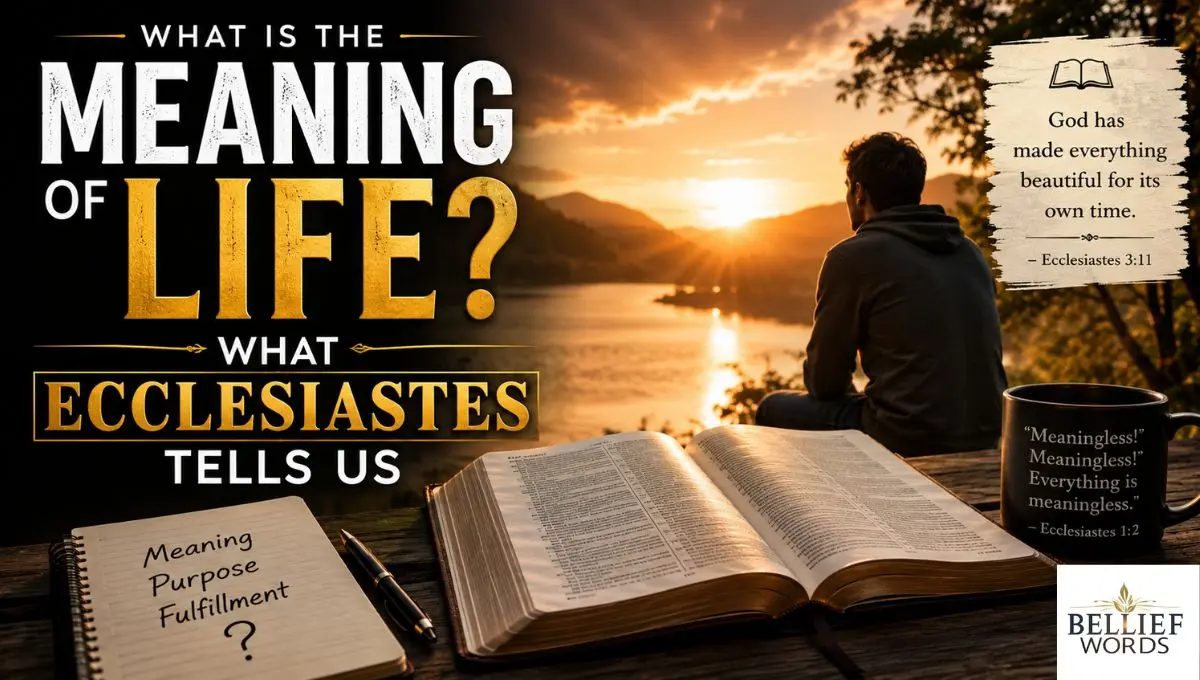
What Is the Meaning of Life? It is one of the oldest and most important questions people have ever asked. Whether during times of success, failure, joy, or loss, everyone longs to discover true purpose.The book of Ecclesiastes addresses this timeless search with remarkable honesty and wisdom.
Written by King Solomon, it explains that lasting fulfillment cannot be found in wealth, work, pleasure, or human wisdom alone. Instead, Ecclesiastes teaches that the meaning of life is found in fearing God, trusting His plan, and living in a relationship with Him. Through Christ, we discover the hope, purpose, and eternal life our hearts truly seek.
Why I Almost Skipped Ecclesiastes (And Why You Shouldn’t)
I’ll be honest: the first time I opened Ecclesiastes, I nearly closed it again.The opening lines sound bleak. The writer, traditionally understood to be King Solomon, calls life “meaningless” over and over. That’s not exactly an inviting start for anyone hoping for encouragement.
But sticking with it changes everything. Ecclesiastes isn’t a book about giving up on life. It’s a book written by someone who tried everything the world offers and is willing to tell you, plainly, what actually worked and what didn’t. That kind of honesty is rare, and it’s exactly why the book still gets read thousands of years later.
A Search for Answers
Ecclesiastes reads like a journal from someone determined to find lasting satisfaction no matter what it costs. The author had the resources to test every theory: wisdom, wealth, projects, pleasure, and status. Rather than guessing at what makes life worthwhile, he ran the experiment himself.
That’s part of what makes this book so relatable. Most of us try to figure out the meaning of life through smaller versions of the same search: chasing a promotion, a relationship, a purchase, or an achievement, hoping it will finally feel like enough. Ecclesiastes tells us, in advance, how that search turns out.
What Is the Meaning of Life? What Ecclesiastes Tells Us
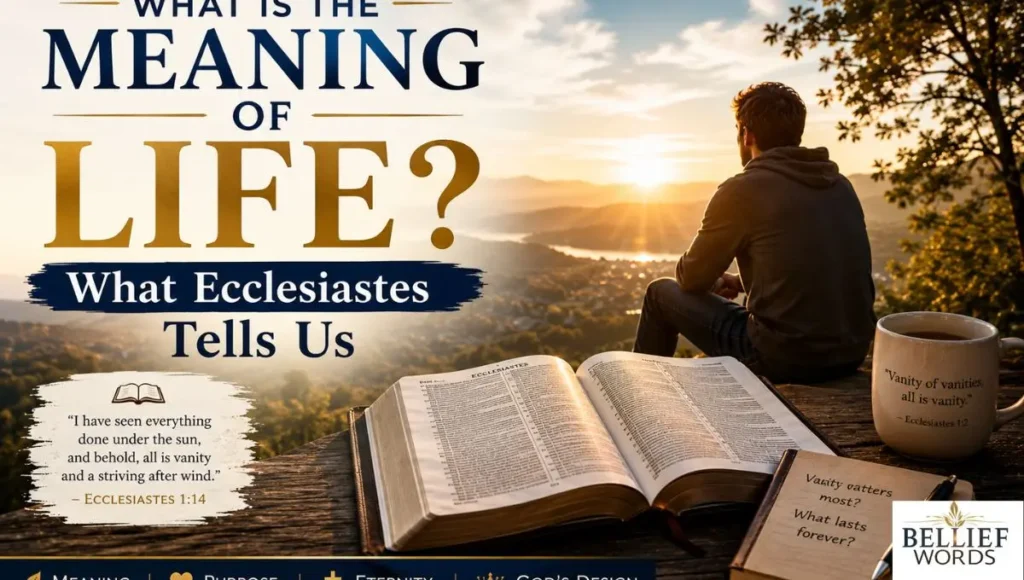
The short answer, according to Ecclesiastes, is this: life “under the sun”meaning life viewed only through what we can see, earn, and enjoy on our own cannot supply lasting meaning by itself. Every pursuit the writer tests eventually runs into the same wall: it fades, it doesn’t satisfy for long, and death erases the difference between the wise and the foolish, the rich and the poor.
But that isn’t the final word. The book’s real conclusion is that meaning is found in relationship with God, in living simply and gratefully within the ordinary days we’re given, and in trusting that a bigger order exists even when we can’t see it. Ecclesiastes doesn’t hand out a five-step formula. It offers something sturdier: a realistic view of life’s limits, paired with an invitation to look beyond them.
Don’t Miss: Biblical meaning of the name Evelyn
When Life Feels Pointless
There’s comfort in knowing that feeling like life is pointless isn’t new, and it isn’t a sign that something is wrong with you. The writer of Ecclesiastes uses the word “vanity” or “meaningless” in many modern translations almost 30 times. He’s not being dramatic for effect. He’s describing something universal: the sense that effort, achievement, and even wisdom itself can feel like grasping at wind.
That word picture is worth sitting with. You can chase the wind all day and never once get to hold it. Ecclesiastes suggests much of human striving works the same way, when we expect it to deliver something it was never built to give.
The Futility of Fleeting Pleasures
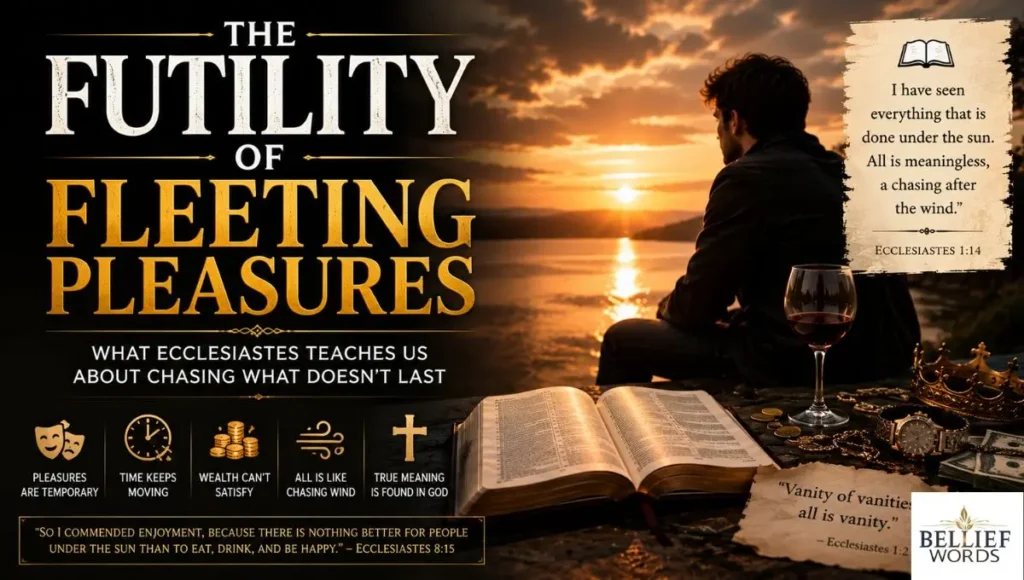
The writer didn’t hold back when it came to pleasure. He tried laughter, wine, music, gardens, and entertainment on a scale most people never approach. His conclusion was blunt: pleasure, on its own, is short-lived. It can lift a mood for an evening, but it can’t anchor a life.
This isn’t a rejection of enjoying good things. Later in the book, the writer actually encourages enjoying food, work, and simple pleasures as gifts. The point is narrower: pleasure makes a poor foundation when it’s asked to be the meaning of life itself, rather than one part of a life lived well.
Can Work, Wealth, and Pleasure Give Life Meaning?
This question sits at the center of Ecclesiastes, and the writer tests all three thoroughly.
| Pursuit | What Solomon Tried | What He Found |
| Wisdom | Studying, learning, seeking understanding | Brought insight, but also more grief and awareness of limits |
| Work | Building houses, vineyards, gardens, and projects | Satisfying in the moment, but he couldn’t control who inherited it |
| Wealth | Accumulating silver, gold, and possessions | Never fully satisfying; more wealth brought more worry |
| Pleasure | Wine, entertainment, luxury | Enjoyable briefly, but empty as a life goal |
None of these were failures in themselves. Work, wealth, and pleasure aren’t treated as bad. They’re treated as incomplete good gifts that were never designed to carry the full weight of human meaning.
Lessons from King Solomon’s Search for the Meaning of Life
Explores Solomon’s wisdom, experiences, and conclusions in Ecclesiastes.
Solomon’s story is worth remembering because of who he was.This wasn’t someone speculating from the outside about wealth or wisdom. He had access to more of both than almost anyone in history, along with unmatched resources for pleasure and achievement. If any human being had the means to prove that life’s meaning could be found “under the sun,” it was Solomon.
His conclusion carries extra weight because of that. He wasn’t a bitter man denied good things; he was a satisfied man who still came up empty.That’s what makes Ecclesiastes such a credible witness rather than a bitter complaint.
A Time for Everything
One of the most quoted passages in the Bible comes from this book: the idea that there’s “a time for every purpose under heaven.” Ecclesiastes lists opposite pairs, a time to plant and a time to uproot, a time to weep and a time to laugh, to describe how life moves in seasons rather than a straight line toward one big payoff.
This rhythm offers real perspective. Instead of expecting every season of life to feel meaningful in the same way, Ecclesiastes suggests we accept the season we’re actually in, whether it’s a season of building or a season of loss, and trust that both belong to a larger, unfolding order.
Eternity in Our Hearts
Here’s one of the book’s most striking observations: God “has set eternity in the human heart.” In other words, we sense there’s more to life than what we can measure, count, or finish in our lifetime. That’s why nothing temporarily fully satisfies us. We’re built with an awareness that stretches past what “under the sun” experience can offer.
This explains the restlessness so many people feel even when life looks good on paper. It’s not a flaw. It’s a signal pointing toward something beyond the visible world.
Wrestling with Injustice and God’s Sovereignty
Ecclesiastes doesn’t shy away from life’s unfairness.The writer notices that wicked people sometimes prosper while good people suffer, and that wisdom doesn’t guarantee reward. Rather than offering a tidy explanation, he acknowledges the tension honestly and points toward trusting God’s timing over human understanding.
That honesty matters. A book that pretended life was always fair would ring false to anyone who has lived long enough to see otherwise.
The Best Way to Live: Remember Your Creator
Toward its conclusion, Ecclesiastes gives some of its most practical advice: remember your Creator, and do it early, before age and hardship make it harder to focus on anything beyond survival. This isn’t just religious instruction. It’s a suggestion about ordering priorities before life forces the question.
The writer’s closing summary is simple: fear God and keep His commands, because this is what life is really about. After chapters of testing every alternative, that’s the one thing he found solid enough to stand on.
True Hope and Meaning of Life
Ecclesiastes doesn’t ask you to abandon work, ambition, or enjoyment. It asks you to hold them loosely, as good gifts rather than ultimate answers, while placing your deeper hope somewhere sturdier. That combination, enjoying ordinary life while trusting something larger than yourself, is the closest thing this ancient book offers to a complete answer.
Conclusion
Ecclesiastes doesn’t dodge life’s hardest question. It walks straight into it, tests every popular answer, and reports back honestly on what it found. Wealth, pleasure, and achievement all fall short as a final answer, not because they’re worthless, but because they were never meant to carry that much weight.
What remains is simpler and steadier: enjoy the life you’ve been given, hold your pursuits loosely, and root your hope in something beyond what fades. That combination is still, thousands of years later, one of the most honest answers anyone has offered to the question of what is the meaning of life.
Frequently Asked Questions
What is the meaning of life according to Ecclesiastes?
Ecclesiastes teaches that lasting meaning isn’t found in wealth, pleasure, or achievement alone, but in living faithfully before God and enjoying life’s simple gifts.
Who wrote Ecclesiastes?
Ecclesiastes is traditionally attributed to King Solomon, described in the text as “the Preacher” or “the Teacher,” son of David.
Why does Ecclesiastes say everything is meaningless?
It reflects on life “under the sun,” meaning life judged only by visible, temporary results, which the writer found unable to satisfy on its own.
What does “a time for everything” mean in Ecclesiastes?
It means life moves through natural seasons, like planting and harvesting or mourning and celebrating, and each season has its place.
What does “eternity in our hearts” mean?
It suggests humans are built with an innate awareness of something beyond earthly life, which is why temporary things never fully satisfy us.
What is the main takeaway from Ecclesiastes?
The book’s closing advice is to remember your Creator, fear God, and keep His commands, since this is presented as the true foundation for a meaningful life.

Welcome to beliefwords! I’m Danish Ali. Christian Faith Writer | 4+ Years Bible Study Experience | Founder of (beliefwords.com)
Sharing prayers, Daliy Bible Verses, Blessings, Name Meanings and biblical wisdom to strengthen your faith.