
You spot a dragonfly hovering near your porch, and something in you pauses. Maybe it lands on your hand, catches the sunlight, and disappears. If you’ve wondered about the biblical meaning of a dragonfly, you’re not alone. Many Christians see this delicate creature as a reminder of transformation, renewal, and God’s presence.
The dragonfly is not mentioned in the Bible, so Scripture gives it no direct symbolic meaning. However, its remarkable transformation from water-dwelling nymph to flying insect can beautifully illustrate biblical themes of spiritual growth and becoming a new creation.
In this guide, we’ll explore the Christian meaning of dragonflies, what Scripture actually teaches, and how to view dragonfly encounters with faith and wisdom.
What Is the Biblical Meaning of a Dragonfly — Quick Answer
In short: the dragonfly represents transformation, spiritual rebirth, and freedom in Christ. Its journey from a water-bound nymph to a winged creature of light mirrors the Christian experience of being “born again” (John 3:3) and becoming a “new creation” in Christ (2 Corinthians 5:17).
While no verse mentions the insect directly, its life cycle is widely used as an object lesson for renewal, adaptability, and walking in the light of God’s truth.
Is the Dragonfly in the Bible — Honest Answer
No, the dragonfly is not mentioned by name in any major translation of the Bible. This is worth stating plainly, since many articles blur the line between scriptural fact and symbolic interpretation.
What the Bible does affirm is that all creation reflects God’s character. Romans 1:20 teaches that God’s “invisible qualities” are understood through what He has made.
So while there’s no dragonfly verse to quote, using the insect as a teaching picture fits a long biblical tradition, the same one that lets Jesus point to lilies, sparrows, and vines to explain spiritual truth.
Dragonfly Transformation — The Science That Matches Scripture

A dragonfly begins life underwater as a nymph, sometimes staying in that stage for up to two years.
It’s a plain, armored creature built for survival in the mud and murk. Then, in a matter of hours, it climbs out of the water, splits its old skin, and emerges with iridescent wings built for flight.
That’s not just a nice metaphor, it’s an almost exact picture of the transformation Christians believe happens at conversion.
Dragonfly Metamorphosis and 2 Corinthians 5:17
Paul writes, “Therefore, if anyone is in Christ, the new creation has come: The old has gone, the new is here!” (2 Corinthians 5:17, NIV). The parallel is hard to miss:
| Dragonfly Stage | Spiritual Parallel |
| Nymph living in murky water | Life before faith, bound by sin |
| Shedding the old exoskeleton | Repentance and letting go of the old self |
| Emerging with wings | New life and identity in Christ |
| Flying in open light | Walking in God’s truth and freedom |
This is the single most common reason believers use the dragonfly as a symbol: it makes an abstract idea (spiritual rebirth) visible.
Dragonfly After Someone Dies — Comfort or Coincidence
One of the most searched questions isn’t really about theology at all. It’s personal: “Why did a dragonfly show up right after my loved one passed?”
There’s no biblical promise that God sends specific insects as messages from the deceased, and Scripture is clear that believers go directly into God’s presence, not into the form of animals or insects (2 Corinthians 5:8).
Still, many Christians find comfort in a dragonfly sighting during grief, seeing it less as a message from the person who died and more as a gentle reminder from God that life continues beyond this world.
Dragonfly After Death of Loved One — 3 Christian Views
- A providential comfort. Some believers see it as a small, God-timed mercy not proof of anything, but a moment of peace.
- A picture of resurrection. Others treat it as a visual sermon: just as the dragonfly leaves the water for the sky, the believer leaves this life for eternity with God.
- Simple coincidence, not a sign. Many pastors caution against reading spiritual messages into nature, encouraging believers to find comfort in Scripture itself rather than animal encounters.
All three views agree on one thing — the comfort should point back to God, not to the insect.
Dragonfly Landing on You — 5 Biblical Interpretations

When a dragonfly lands on you specifically, it can feel personal. Here are five common interpretations Christians draw from Scripture’s themes, even without a direct verse:
- A call to stillness like Psalm 46:10, “Be still, and know that I am God.”
- A reminder of transformation already at work for you.
- A nudge toward gratitude for God’s creation (Psalm 19:1).
- A prompt to reflect God’s light, much like believers are called to be “light of the world” (Matthew 5:14).
- Simply a curious insect and it’s okay for it to be nothing more than that.
Don’t Miss: Before Surgery Wishes and Prayers: 144+ Heartfelt Messages
Dragonfly Landing on Your Hand Meaning
A dragonfly landing on your hand is often interpreted as a symbol of God’s provision and care resting close to you, a small, tangible encouragement in the middle of an ordinary day.
Dragonfly Landing on Your Head Meaning
Because the head is associated with thought and identity, some Christians read this as a picture of Romans 12:2 the “renewing of your mind” a reminder that transformation starts with how you think.
What Does a Dragonfly Symbolize in Christianity?
Across most Christian writing, the dragonfly symbolizes:
- Transformation and new life
- Freedom from past sin or limitation
- Light, clarity, and truth
- Adaptability and trust in God’s leading
- The fleeting, delicate nature of life on earth
Dragonfly Spiritual Meaning: What Christians Can Learn From It
Beyond symbolism, the dragonfly offers a practical lesson. It thrives in two completely different environments: water and air without losing what it is.
For believers, that’s a picture of living “in the world but not of it” (John 17:16), adapting to circumstances while staying anchored in faith.
Does God Use Dragonflies as Signs? What the Bible Says
The Bible does record God using nature, a burning bush, a dove, a rainbow to communicate. But these were specific, historical, and confirmed by God’s own word, not general patterns believers should expect to repeat.
Scripture doesn’t promise insects as signs. Most sound biblical teaching encourages seeing dragonflies as reminders that point back to biblical truth, not as new revelation in themselves.
Dragonfly Colors and Their Christian Meanings
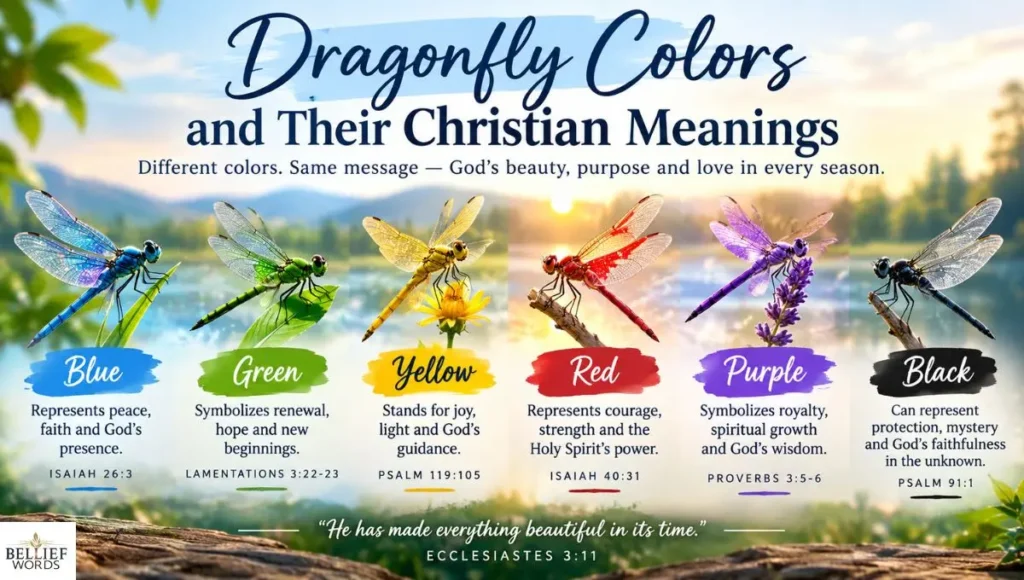
Color symbolism isn’t found in Scripture regarding dragonflies specifically, but many believers layer familiar biblical color meanings onto their sightings.
Blue Dragonfly Biblical Meaning
Blue is often tied to peace, heaven, and the Holy Spirit, a reminder of calm and divine presence.
Green Dragonfly Biblical Meaning
Green connects to growth, renewal, and new beginnings, echoing spring imagery used throughout Scripture.
Red Dragonfly Biblical Meaning
Red is commonly linked to sacrifice and the blood of Christ, making a red dragonfly a symbol some associate with redemption.
Prayer When a Dragonfly Visits You
“Lord, thank You for the beauty in Your creation. Just as this dragonfly was transformed, continue transforming me from the inside out.
Help me leave behind what holds me back and walk in the freedom and light You’ve given me through Christ. Amen.”
Dragonfly vs Butterfly — Which Is More Biblical
Neither insect appears in Scripture, so “more biblical” really means which metaphor Christians have leaned on more historically and that’s the butterfly, largely through Easter and resurrection art.
The dragonfly is a newer, growing symbol, especially popular in personal testimonies and grief support.
Dragonfly vs Butterfly — Transformation Comparison
| Feature | Dragonfly | Butterfly |
| Metamorphosis type | Incomplete (nymph to adult) | Complete (cocoon stage) |
| Common Christian theme | Freedom, light, adaptability | Resurrection, new life |
| Historical church use | Less traditional, growing today | Long-standing Easter symbol |
| Habitat shift | Water to air | Ground to air |
Conclusion
The biblical meaning of a dragonfly isn’t written in a verse, but it’s written all over the creature’s own life story. From murky water to open sky, it echoes a truth the Bible teaches again and again that God specializes in turning old things into new.
Whether you saw one after a loss, felt one land on your hand, or simply looked one up out of curiosity, let it point you somewhere familiar: back to Scripture, back to the God who transforms, and back to the freedom already offered to you in Christ.
Frequently Asked Questions
Is the dragonfly mentioned in the Bible?
No, dragonflies aren’t named in any standard Bible translation; their symbolism comes from interpretation, not direct Scripture.
What does it mean spiritually when a dragonfly visits you?
Many Christians see it as a gentle reminder of transformation, God’s presence, or a call to stillness and reflection.
Does a dragonfly after death mean my loved one is okay?
The Bible doesn’t support that idea directly, but many find comfort viewing it as a picture of resurrection and God’s care during grief.
What does a dragonfly symbolize in Christianity overall?
It generally symbolizes transformation, freedom in Christ, light, and adaptability in faith.
Are dragonfly colors biblically significant?
Not explicitly, but believers often apply familiar biblical color meanings, like blue for peace or red for sacrifice.
Is the dragonfly more biblical than the butterfly?
Neither appears in Scripture; the butterfly has stronger historical ties to Easter, while the dragonfly is a newer, popular symbol of transformation.

Welcome to beliefwords! I’m Danish Ali. Christian Faith Writer | 4+ Years Bible Study Experience | Founder of (beliefwords.com)
Sharing prayers, Daliy Bible Verses, Blessings, Name Meanings and biblical wisdom to strengthen your faith.